
When most people hear the word “scammer,” they probably picture someone sitting in a dark room, wearing a hoodie, and typing away on several computer screens.
Sometimes that might be true.
But a scammer can also be someone calling your phone, sending you a text message, creating a fake social media account, pretending to be your boss, or even posing as a family member who suddenly needs money.
So, what is a scammer? 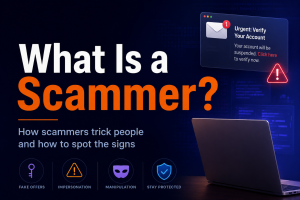
A scammer is someone who uses lies, manipulation, or deception to convince another person to give them something valuable. That could be money, personal information, login credentials, gift card numbers, account access, or even control of a computer or mobile device.
Scammers do not always “hack” their way into an account. A lot of the time, they simply convince someone to open the door for them.
What Does a Scammer Actually Do?
A scammer creates a situation that feels believable enough to make you take action.
They might tell you:
- Your bank account has been compromised.
- Your package could not be delivered.
- You owe money to the government.
- You won a large prize.
- Your boss needs you to buy gift cards.
- A family member has been arrested or injured.
- Your computer has a serious virus.
- An investment opportunity is about to disappear.
The details can change, but the goal is usually the same.
The scammer wants you to act before you have time to stop, think, and verify what is happening.
Scammers Are Really Manipulators
Scammers understand human behavior.
They know that people are more likely to make mistakes when they feel scared, excited, curious, embarrassed, or rushed. That is why so many scams try to create a strong emotional reaction.
A message might say your account will be closed within 30 minutes.
A caller might tell you that your child is in danger.
An email might claim you have won a million dollars, but you need to pay a small processing fee first.
The scammer is not giving you time to think clearly. They are trying to move you from emotion to action as quickly as possible.
Scammers Do Not Always Look Suspicious
One of the biggest misconceptions about scammers is that they are easy to recognize.
Modern scams can look incredibly professional.
A fake email may include the correct company logo. A fraudulent website might look almost identical to your bank’s real website. A scam text could appear in the same message thread as legitimate delivery notifications.
Scammers may also know your name, employer, phone number, address, or the names of people you work with.
That does not mean the message is legitimate.
A lot of personal information is publicly available through social media, company websites, data breaches, people-search websites, and online databases. Scammers can use these details to make a fake story feel much more personal.
What Is the Difference Between a Scammer and a Hacker?
A hacker usually tries to gain unauthorized access to a device, network, system, or account.
A scammer usually tries to manipulate a person.
There can be a lot of overlap between the two. A scammer may use stolen information from a data breach. A hacker may send a phishing email to trick someone into revealing a password.
But many successful scams do not require advanced technical skills.
The scammer only needs to create a believable story and convince someone to respond.
This is why people are often considered one of the most vulnerable parts of an organization’s security.
Who Do Scammers Target?
Scammers target everyone.
They target older adults, teenagers, parents, employees, business owners, job seekers, online shoppers, investors, and people looking for relationships.
They also target companies of every size.
A small business might receive a fake invoice. An employee may receive an email that appears to come from the CEO. A payroll department could be asked to change an employee’s direct deposit information. A vendor may receive fraudulent wiring instructions.
Scammers do not necessarily choose victims because they think those people are unintelligent.
They look for opportunity, timing, emotion, and access.
Anyone can fall for a scam when the right message reaches them at the wrong moment.
What Are the Most Common Types of Scammers?
There are many different types of scammers, but most of them use similar tactics. 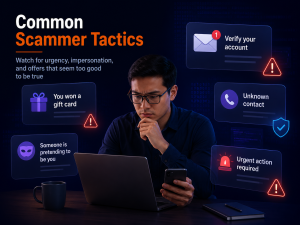
Phishing Scammers
Phishing scammers send emails, text messages, or social media messages designed to steal information or get someone to click a malicious link.
They often impersonate banks, delivery companies, government agencies, streaming services, or employers.
Impersonation Scammers
These scammers pretend to be someone you already know or trust.
They may pose as your boss, coworker, family member, police officer, bank representative, or technical support agent.
Romance Scammers
Romance scammers build emotional relationships with people online and eventually begin asking for money.
They may spend weeks or months building trust before creating an emergency.
Investment Scammers
Investment scammers promise fast, easy, or guaranteed returns.
They may promote cryptocurrency, real estate, business opportunities, or fake trading platforms.
Prize and Sweepstakes Scammers
These scammers tell people they have won money, a vacation, or another valuable prize.
The victim is then asked to pay a fee, provide banking information, or share a credit card number before receiving the supposed prize.
Business Email Scammers
These scammers impersonate executives, employees, customers, or vendors.
They may request gift cards, wire transfers, payroll changes, confidential documents, or urgent payments.
Why Are Scams Becoming Harder to Spot?
Scammers now have access to better technology.
They can create realistic websites, clone voices, generate convincing emails, edit images, automate messages, and gather personal information from many different sources.
Artificial intelligence can also help scammers write cleaner messages with fewer spelling mistakes. It can be used to create fake voices, realistic images, and personalized conversations.
This does not mean every suspicious message was created with artificial intelligence.
It simply means that the old advice of “look for bad grammar” is no longer enough.
A scam can be well-written, professional, and still be completely fake.
How Can You Protect Yourself From a Scammer?
The best thing you can do is slow down.
Scammers want speed. Verification works against them.
Before sending money, sharing information, downloading a file, or clicking a link, ask yourself a few simple questions:
- Was I expecting this message?
- Is the person creating unnecessary urgency?
- Am I being asked to keep something secret?
- Is the request unusual?
- Can I verify this through another method?
- Does the offer sound too good to be true?
Do not use the phone number, email address, or link provided in a suspicious message.
Instead, go directly to the company’s official website, use a trusted phone number, or contact the person through a communication method you have used before.
What Should You Do If You Think You Are Talking to a Scammer?
Stop communicating with them.
Do not send additional money or information.
Take screenshots, save emails, document phone numbers, and contact the company or financial institution involved. If you shared a password, change it immediately and turn on multi-factor authentication.
You may also need to contact your bank, credit card provider, employer, local police department, or the appropriate fraud reporting agency.
Most importantly, do not let embarrassment stop you from reporting what happened.
Scammers depend on people staying quiet.
The Best Defense Is Awareness
A scammer is not just someone trying to steal your money.
A scammer is someone trying to control your decision-making.
They create pressure, build trust, trigger emotion, and make fake situations feel real.
The more often people learn about these tactics, the easier it becomes to recognize them before taking action.
That is the idea behind AwairLab. Instead of relying only on long annual training sessions, AwairLab delivers short, comic-style security and scam awareness lessons directly to employees throughout the year. The goal is to make important messages easier to notice, remember, and use when a suspicious situation actually happens.
A scam only needs a few seconds of trust to work.
Awareness gives you those few seconds back.